March 12, 2026 · 7 min read
Pressure Drop Is The Real Enemy
Every foot of pipe, every fitting, and every filter costs you PSI. If your compressor makes 125 PSI and your tool needs 90, you have 35 PSI of budget to spend on the trip out. Most poorly designed systems burn 20 to 30 PSI just in the piping, then blame the compressor.
Every 2 PSI of unnecessary discharge pressure costs about 1 percent more energy. Undersized piping literally raises your electric bill every hour the compressor runs.
Loop vs Branch Layout
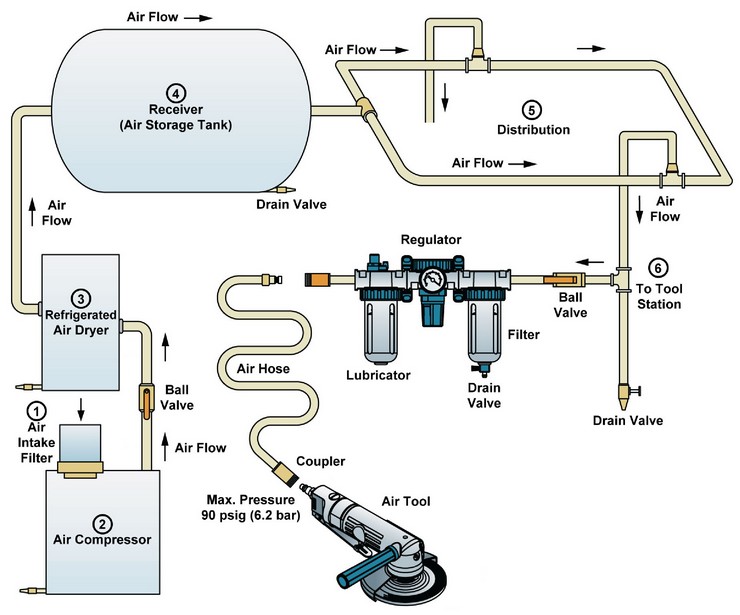
A loop header feeds air to any point from two directions, so pressure stays even when a big tool kicks on. A branch (tee-off) header feeds from one direction only - the furthest drop sees every drop in pressure that all the drops upstream cause.
For any plant with more than a couple of workstations, loop the header. It costs a little more pipe and pays for itself in stable pressure and lower compressor discharge setpoint.
Sizing Mains And Drops
Size the main for the total system CFM plus 30 percent for future growth. Size each drop for the peak CFM of the tools it serves. Undersized drops are the single most common reason a workstation loses pressure when three tools run at once.
Take drops off the TOP of the main, not the bottom or side. That keeps condensate out of your tools and pushes it to a drip leg.
Not sure what size main your plant needs? Send us your CFM demand and layout - we will spec it.
Size my pipingMaterial: Aluminum vs Steel vs Copper vs Black Iron
Material affects install time, pressure drop, corrosion, and future flexibility. For most industrial plants today, modular aluminum is the default answer. Steel is right for high-abuse or high-pressure environments. Copper still has a place in shops. Black iron is what we usually rip out.
| Material | Best For | Watch Out For |
|---|---|---|
| Modular Aluminum | Most industrial and manufacturing plants; fast to install; smooth bore lowers pressure drop; easy to modify later. | Cost per foot higher than steel; needs proper support spacing. |
| Schedule 40 Steel | High-pressure, high-vibration, or heavy-abuse environments. | Interior scale over time can add pressure drop and rust downstream. |
| Type L Copper | Smaller shops, clean environments, dry air only. | Cost swings with commodity prices; not ideal for larger CFM plants. |
| Black Iron | Cheap up-front. That is it. | Scales, rusts, dumps particles into your tools. Almost never the right long-term choice. |
Drip Legs, Drains, And Isolation Valves
Even with a dryer, some condensate will collect at low points and dead ends. Put a drip leg at the bottom of every drop, with a drain valve. Put isolation ball valves on every branch so you can service a section without shutting the plant down.
These fittings cost pennies during install and save hours during every repair for the next 20 years.