

April 2, 2026 · 7 min read
What 'Clean, Dry Air' Actually Means
The industry speaks in ISO 8573-1 classes. Each class rates three things: solid particles, water content (dew point), and oil content. Class 1 is the strictest; higher numbers are looser.
Match the class to what you actually need. Painting and food need tight classes. General plant air can run looser. Buying to Class 1 across the board when you only need Class 4 wastes capital and energy.
| Use Case | Typical ISO Class | Dew Point Target |
|---|---|---|
| General plant air, pneumatic tools | Class 4 or 5 | 38 - 45 F |
| Painting, powder coating | Class 2 or 3 | 38 F, oil under 0.1 mg/m3 |
| Food, beverage, packaging | Class 2 | 38 F, oil-free rated |
| Pharma, lab, breathing air | Class 1 | -40 F, oil-free rated |
Refrigerated vs Desiccant Dryers
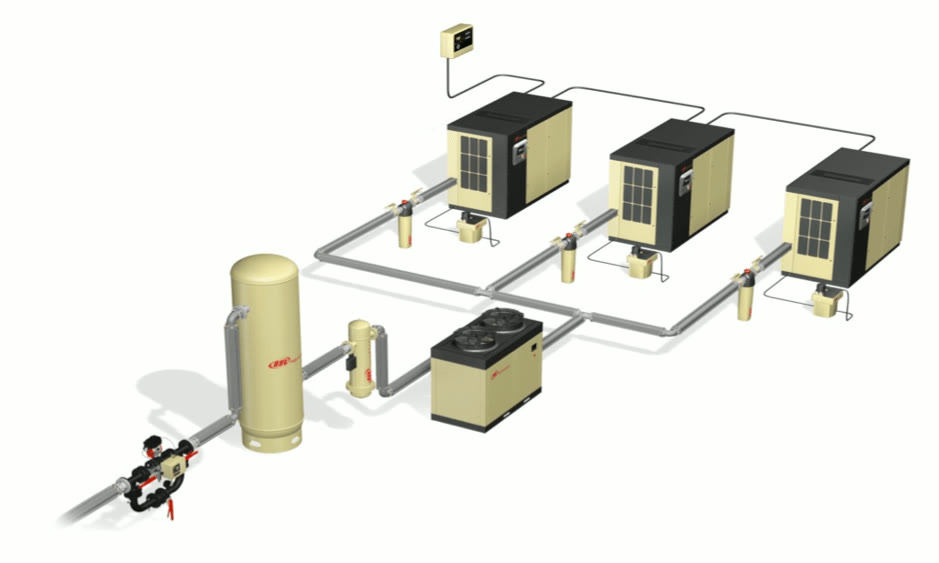
A refrigerated dryer chills the air to condense out water, then re-warms it. It gets you to about a 38 F pressure dew point - fine for most plant air. It uses about 1 percent of the compressor's energy.
A desiccant dryer runs the air over a chemical bed that adsorbs moisture, then regenerates the bed. It gets you to a -40 F dew point or better - what you need for freezing lines, outdoor piping, or Class 1 applications. It uses more energy (purge or heat), so only spec it where you truly need the dryness.
Filter Stages: Coalesce, Particulate, Carbon
Filters come in stages, each doing one job:
- Coalescing filter (0.01 micron): pulls oil aerosols and water carryover out of the air stream. Always first, right after the dryer.
- Particulate filter (1 micron or finer): catches solid contaminants - pipe scale, dust, rust. Right after the coalescer.
- Activated carbon filter: removes oil vapor and odor. Required for painting, food, and any oil-sensitive process.
Send peak CFM, current pressure, and end-use. We will spec the right stack.
Size my dryer + filtersDrains: The Detail That Kills Air Quality
Every filter and every dryer produces condensate. Manual petcocks depend on someone opening them - and no one does, until water shows up at the tool.
Use zero-loss electronic drains at every point. Route them through an oil-water separator sized to the plant's total condensate load, then to a floor sink. This is often required by local code for oil-lubricated compressor discharge.
Size To Peak CFM, Not Nameplate
Sizing dryers and filters to the compressor's rated CFM is wrong on both sides. Compressors rarely make their brochure rating in the real world, and dryers see higher inlet temperatures than the test lab.
Size the dryer and filters to actual peak demand at actual inlet conditions - inlet temp, humidity, and operating pressure - with 25 percent headroom for future expansion.